ALFTANET
← All guides

Why one-button games are secretly the hardest

Give a game a single input and something counter-intuitive happens: it becomes instantly approachable and, at the top end, brutally demanding. Here's why the simplest controls so often produce the deepest skill.

There's a certain snobbery about one-button games — the assumption that fewer controls must mean less game. Anyone who has actually chased a high score in one knows better. Removing inputs doesn't remove difficulty; it relocates it. When you can only do one thing, the entire challenge collapses onto a single question: when. And timing, it turns out, has a much higher skill ceiling than most people expect.

Fewer inputs, more attention

Every control a game gives you is something you have to think about. Take them away and the thinking doesn't disappear — it concentrates. In a one-button game there's nothing to fumble, no wrong button to hit, no split attention between movement and aiming. All of that mental budget pours into reading the situation and picking the exact right instant to act. That's why these games feel so pure: there's no barrier between your understanding of the game and your ability to express it. If you die, it wasn't the controls. It was you, a fraction of a second early.

The easy-to-learn, hard-to-master curve

The best one-button games are learnable in a single sentence. "Tap to flip gravity." "Hold to grapple, release to fly." "Tap to drop the block." You understand the rule immediately, which means you're playing — and failing, and wanting one more go — within seconds. But the gap between understanding the rule and executing it consistently is enormous, and it's a gap you close through feel rather than knowledge. That combination, a floor anyone can step over and a ceiling almost nobody reaches, is exactly what makes an arcade game endlessly replayable.

Timing is a trainable skill

Raw reaction time is mostly fixed — you can't practise your way to a dramatically faster nervous system. But timing in a one-button game isn't really reaction; it's anticipation and rhythm, and both improve steadily with play. You start to feel the beat of a gliding block, the arc of a swing, the moment before an obstacle. Experienced players aren't reacting faster; they're acting earlier, because they've learned to read the pattern before it fully arrives. That's why a one-button game can keep rewarding you for weeks: you're not maxing out a physical limit, you're refining a sense.

Three ways one button can feel completely different

What's striking is how much variety a single input can produce depending on what it does. A tap can be a switch, a release, or a commitment, and each creates its own kind of tension.

A switch: in Gravity Dash, one tap flips gravity from floor to ceiling. The challenge is reading a fast, scrolling track and committing to each flip a beat early.
A release: in Tether, you hold to grapple and let go to fly, so the skill is choosing the exact point in a swing's arc to let go for maximum speed.
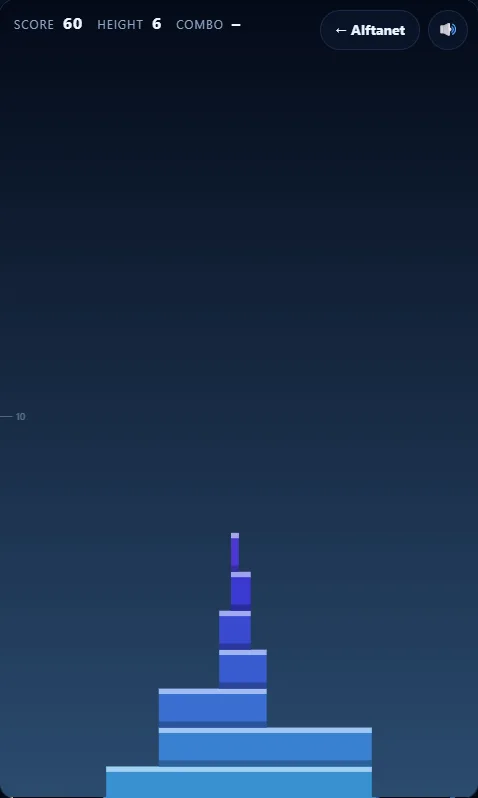
A commitment: in Overstack, one tap drops a block, and any misalignment shears it thinner forever — so every tap carries the weight of the whole run.

Made for the way we actually play now

There's a practical reason one-button games have thrived in the browser and on phones: they fit the moment. A single tap works identically on a mouse, a touchscreen or a spacebar, so a one-button game plays the same everywhere with no control scheme to explain. It's ready the instant the page loads and it makes sense in a thirty-second window. In a world where a game has seconds to earn your attention, doing one thing extremely well beats doing ten things adequately — which may be the most modern idea the old arcade ever had.