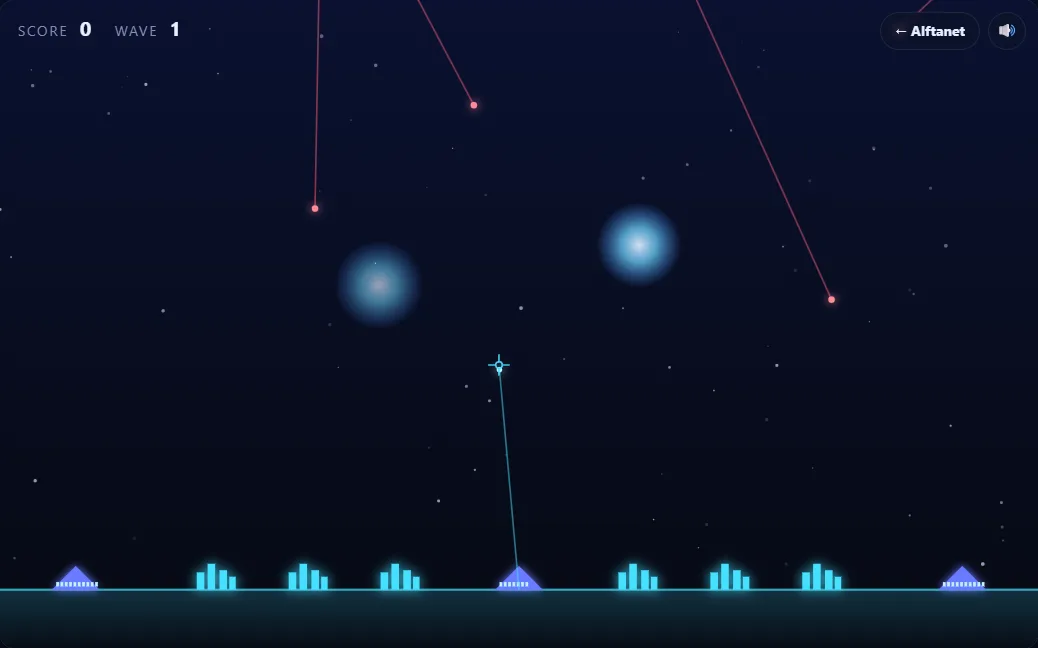
Reading a Missile Command board
Almost everyone plays Missile Command as a shooting game — track the incoming, shoot the incoming. It's actually a defence game with a scoring system that tells you exactly what matters, and most players are optimising for the wrong thing entirely.
This is a strategy guide for Skyguard, our take on the 1980 Atari classic. The specific numbers are ours, but the underlying insight applies to essentially every game in this lineage, including the original.
The board
You defend six cities with three missile batteries — one at each edge and one in the middle. Each battery holds ten counter-missiles per wave, and all three refill completely at the start of every wave. You aim with the cursor and your counter-missile detonates where you clicked, destroying anything caught in the blast.
Enemies come in four flavours, and they arrive faster and thicker each wave:
- Plain missiles — straight lines from the top of the screen. The bulk of every wave.
- Splitters — appear from wave 2, and break into multiple warheads partway down. One shot early is worth three shots late.
- Smart missiles — from wave 3. Noticeably slower than the others, but they actively steer around your detonations.
- Bombers — from wave 4. They cross horizontally rather than falling, and they're worth more than anything else on the screen.
The scoring table nobody reads
Here's where the real strategy lives. Kills are worth points, scaled by the wave number:
| Target | Base value | At wave 10 |
|---|---|---|
| Plain missile | 25 × wave | 250 |
| Splitter | 40 × wave | 400 |
| Smart missile | 60 × wave | 600 |
| Bomber | 125 × wave | 1,250 |
And then, at the end of each wave, two bonuses:
| Bonus | Value | At wave 10 |
|---|---|---|
| Each surviving city | 100 × wave | 1,000 each |
| Each unused missile | 5 (flat) | 5 each |
What those numbers actually mean
Look at the two bonuses together, because the asymmetry between them is the whole game.
The city bonus scales with the wave. The ammo bonus doesn't. At wave 10, one surviving city is worth 1,000 points. Your entire unspent arsenal — all thirty missiles, if you somehow cleared a wave without firing — is worth 150.
One city is worth more than seven full loadouts.
This inverts the instinct almost every player has. It feels responsible to conserve ammunition; you've got thirty shots and a screen full of threats, so you ration. That instinct is costing you enormous amounts of score. The correct policy is close to the opposite:
Spend everything. Ammunition you didn't fire is worth almost nothing, and it refills for free next wave. If firing three counter-missiles at one incoming warhead gives you a better chance of saving a city, fire all three. If you end a wave with ten missiles spare and one city destroyed, you played it wrong by roughly 850 points at wave 10 — and the gap widens every wave after, because that city would have paid out again and again.
The compounding city
That last point deserves its own heading, because it's the single biggest idea in the game. A city isn't worth its bonus once. It's worth its bonus every remaining wave.
Lose a city at wave 3 and you haven't lost 300 points. You've lost 300 at wave 3, 400 at wave 4, 500 at wave 5, and so on for as long as your run continues. A city that survives to wave 12 has paid out roughly 7,800 points on its own. Two players who reach the same wave with different city counts aren't close on score — they're in different leagues.
So the mental model to play with isn't "shoot down the missiles". It's: which of my cities is currently threatened, and what will it cost me to keep it? Everything else is secondary.
Reading the threat, not the screen
Once you accept that cities are everything, targeting priority follows.
Trace trajectories, don't chase objects. A missile heading for empty ground between two cities can be ignored entirely, even at wave 12 with everything screaming. Every shot you spend on a harmless missile is a shot you don't have for a dangerous one. Beginners shoot the nearest thing; good players shoot the thing that's aimed at something.
Kill splitters high. This is the one exception where acting early beats acting economically. A splitter intercepted before it breaks is one kill; after it breaks it's several fast warheads on divergent paths, often over different cities. The moment you see one, it becomes your priority regardless of what it's currently aimed at, because what it's aimed at is about to change.
Lead the smart missiles, don't cover them. Smart missiles steer around your blasts, so detonating directly on top of one usually just makes it swerve. Because they travel at about 70% of normal speed, you have more time than you think — put the blast where it's going to be after it dodges, or bracket it with two shots so there's nowhere to swerve to. Their slowness is a gift; use it to think rather than panicking.
Take bombers when they're cheap. At 125 × wave they're by far the best points on the board, and they cross horizontally on a predictable line. But they're a scoring opportunity, not a threat to your cities in the same immediate way. Take them when the sky is quiet; ignore them when three warheads are converging on your last city.
Using three batteries properly
Each battery has its own ten missiles, and its shots travel from its own position — so the centre battery reaches most of the board quickly, and the edge batteries are slow to cover the far side.
The failure mode is draining the centre battery on everything because it's the most convenient, then finding it empty when something threatens the middle cities. Use the edge batteries for threats on their own side even when the centre could technically make the shot. Think of the centre's ammunition as your reserve for whatever goes wrong.
Losing a battery outright costs you a third of your firepower for the rest of the run, which is one of the few things worth spending shots to prevent even at the cost of a city — but only early, when there are many waves left to feel it.
How the difficulty actually ramps
Worth knowing so you can pace yourself. Each wave brings about two more enemies than the last, they move meaningfully faster, and the gap between spawns shrinks — the wave arrives as a stream early on and as a barrage later.
The proportion of nasty enemy types climbs too, but it caps: splitters top out at around 40% of a wave and smart missiles at about 30%. So there's a point, somewhere in the low teens, where the mix stops getting worse and only the speed and volume keep rising. Runs don't end because a new horror appears; they end because you run out of time to think.
Which is the last piece of advice: the skill that improves most with practice isn't aim, it's triage. Deciding fast which three of the eleven objects on screen actually matter is the whole game at high waves, and it's a decision you can only make quickly if you've already internalised that cities are worth an order of magnitude more than kills.
The five-line summary
- Cities are worth ~7× more than your entire unused arsenal, and they pay out every wave.
- So spend all your ammunition freely — it refills, and it's nearly worthless banked.
- Ignore anything not on course for a city or a battery.
- Splitters die high; smart missiles get led or bracketed; bombers are dessert.
- Keep the centre battery in reserve.
→ Play Skyguard · → How to get better at browser arcade games