ALFTANET
← All guides

The one number that made our survival game work

Danger isn't pressure. A game can be full of things that hurt you and still feel like a puzzle you're solving at your own pace. Here's the stat that fixed that in Castaway, and why the fix was to make the player's compass worse.

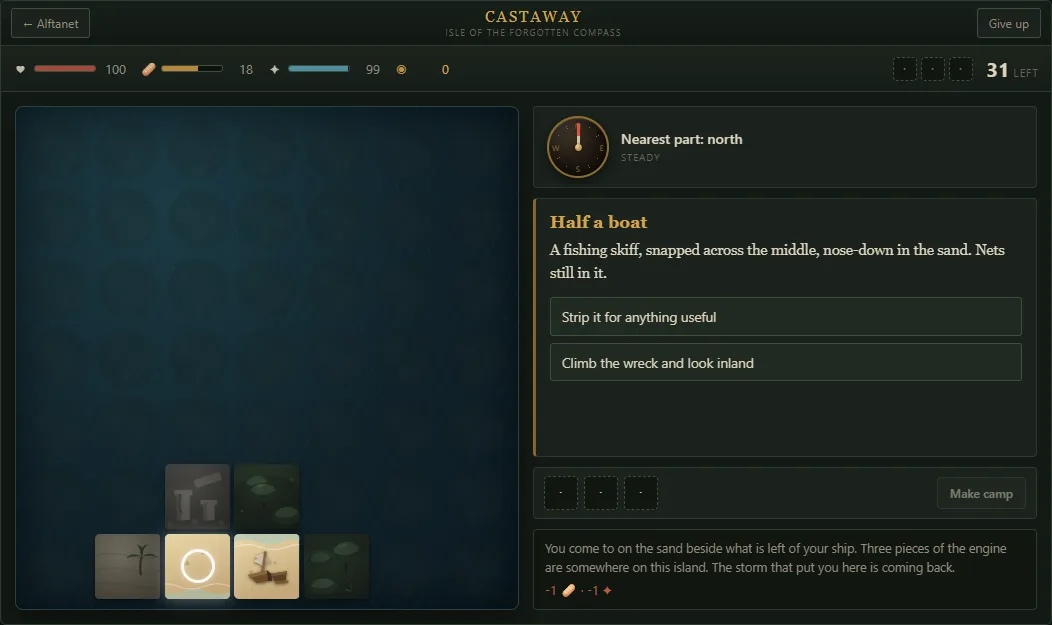
Castaway is a turn-based island expedition. You're wrecked on a shore, three pieces of your ship's engine are somewhere inland, and a storm is coming back for you. Walk to a tile, deal with whatever is on it, and get all three parts to the wreck before your rations, your health or the weather run out.

The first playable version had all of that. It also had a problem we couldn't name for a while: it wasn't tense. Things attacked you, food ran down, and none of it made your hands sweat. It played like an errand.

Why "resources that go down" isn't pressure

The version we had was, on paper, a proper survival game. Health that could drop. Rations that drained each turn. A hard turn limit before the storm. Three resources, all shrinking, all fatal at zero.

The trouble is that those pressures are all legible and linear. You can look at 19 rations and 32 turns and do arithmetic. Once a player can do the arithmetic, the game stops being survival and becomes routing: work out the cheapest tour of the three parts, walk it, go home. The danger is real but it's a cost you budget for, and budgets aren't frightening.

What the game was missing was something that degraded your ability to make good decisions, rather than just taxing the decisions you'd already made.

Nerve, and the compass that lies

The fix was a fourth stat we call nerve, and one rule connecting it to the interface.

Your only navigation aid is a compass that points toward the nearest engine part. It doesn't tell you how far — just a direction. That's already a nicely incomplete piece of information. The change was this: the compass gets less accurate as your nerve drops.

Nerve bleeds a little every turn you're away from the shore, and it bleeds faster the deeper in you go — the beach costs you barely anything, the jungle more, the ruins more again, and the slopes of the volcano most of all. So the longer you stay out, and the further in you push, the less you can trust the one thing telling you where to go.

That single connection is what turned the game around, because it makes time cost something that isn't subtractable. Every extra turn inland is paid for in the quality of your information. You're no longer solving a map — you're trying to finish before you lose the ability to read it.

You can feel the difference within about ten turns. Play Castaway →

The decision it creates

Good pressure shows up as a decision the player genuinely doesn't know how to make, and nerve produces one immediately.

You can make camp: spend a turn and two rations to recover some health and some nerve. It's the only way to buy your judgement back without stumbling into a lucky event. So every few turns you face the same trade — the storm is coming, so stopping costs you a turn you may desperately need at the end; but pushing on means the compass gets vaguer, which means you'll wander, which costs more turns than the camp would have.

There's no formula for that. It depends on how far in you are, how many parts you're still missing, how much food you're carrying, and how badly you need the health. That's exactly the texture we wanted: a decision that a good player makes better than a bad one, but that neither can compute.

It also gives the item shop a real shape. A fever tonic that restores nerve isn't a stat top-up, it's a turn you don't have to spend at camp. A spyglass that reveals hidden tiles is insurance against a compass you've stopped trusting. Both are competing for the same gold as bandages and food, which are competing for the same gold as each other.

The other half: making sure the deadline is always real

A deadline only creates pressure if it's tight on every run, and this is where procedural generation quietly betrays you. If the three parts happen to land near each other, the storm is a formality. If they land in three corners, the run was unwinnable before you made a single decision. Both of those are the generator making the game's central tension random.

So the map generator doesn't get the final say. After it places everything, we work out the length of the best possible tour — wreck to all three parts and back — and the map is only allowed to demand a tour up to a fixed maximum. The turn budget is then set just above that maximum.

The result is that on any map you're given, a perfect route finishes with a small margin and nothing else does. The storm is a genuine deadline every single time, rather than only on the unlucky maps. And because the check runs after generation rather than constraining it during, the islands still feel varied — you just never get an impossible one.

That rule — generate freely, then verify the generated thing is actually playable, and regenerate if it isn't — is one we now apply everywhere. It came out of a different game entirely, where a procedural track could occasionally spawn two hazards close enough together that no reaction could clear both. Checking the output is nearly always cheaper than writing a generator careful enough not to need checking.

The difficulty setting we're happiest with

Hard mode doesn't add enemies or make things hit harder. It gives you fewer turns, less food, slightly worse luck, and — the one that actually bites — an extra point of nerve drain per turn.

That last one means your compass degrades faster than you can walk, and the whole calculus shifts. On normal you can usually afford to explore a little. On hard, exploration is a luxury; you're navigating on a failing instrument from about the halfway mark, and the difficulty is felt as uncertainty rather than as damage.

Making a game harder by giving the player worse information, rather than worse odds, is the thing we'd most encourage anyone to try. Worse odds feel unfair, because you played correctly and lost anyway. Worse information feels tense, because you're the one who decided to push on with a compass you weren't sure about.

The general lesson

If a survival game feels flat, the instinct is to add more threats or turn the numbers up. In our experience that usually makes it more punishing without making it more tense, because it's still the same legible arithmetic with bigger coefficients.

The thing to look for instead is whether time costs the player anything they can't put on a spreadsheet. Attach the passage of time to the quality of their information — the map, the compass, the visibility, the reliability of what the game is telling them — and pressure appears more or less on its own.